
What Is Behind China's Success?
2006-03-14
Bartłomiej Magierowski
In every magazine, on the radio, and on television, there is more and more talk about China! The reason... incredible progress and development, which some people even see as a threat and a source of global instability. We already know China's GDP growth percentages, unemployment rates, the RMB-to-dollar exchange rate, the economic growth rates of individual cities. We know all the figures and dry facts, but in reality, none of us really wonders what this success in China is actually based on.
Hard-line opponents of the Chinese government and Chinese communism will say that it is probably about exploiting cheap labor, or even free labor, referring to prisons and labor camps. However, I do not believe this is the main factor driving the Chinese economy. Someone else might say that it is about exporting cheap, low-quality products. Perhaps to some extent this is true, but the biggest profits come from expensive products, high-quality goods, such as SMD devices, computers, specialized measuring equipment, advanced technologies, and modern cars. There may be many reasons, but they all come down to one thing – ordinary hard work.
Leaving aside the political system, it is enough to look at the streets, construction sites in major cities, or even huge bridges connecting villages separated by reservoirs or lakes (as is the case near YueYang city in Hunan Province). Here, people simply work hard. It does not matter whether it is Saturday or Sunday, evening or night – work continues everywhere. Residential skyscrapers and office buildings appear here month after month. While writing this text, I turn around from time to time, look through the window, and every few days I see another floor being added to the newly constructed apartment building.
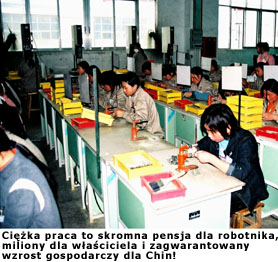 Traveling along the Guangzhou-Shenzhen route, even at night and on Saturdays, I see the heads of factory workers bent over tables in illuminated production halls. They are soldering wires, assembling mobile phones, testing batteries, and putting together watches and toys. The situation is the same near Yangzhou. It is a small village whose residents have already forgotten about farming. Old warehouses and barns have been transformed into factory complexes with simple dormitories for workers. Everyone produces plush toys and earns increasingly more money from it. During my two years in China, I have never driven on a highway that was not being widened, rebuilt, modernized, or crossed by a new overpass, another highway, or a bridge. New roads usually have five or even six lanes in one direction. When building a hotel in China, it is now almost expected to include a helicopter landing pad, at least thirty floors, a huge fountain in front of the entrance, and marble stairs, columns, and floors. In the Middle Kingdom, nothing is spared: steel, coal, marble, granite. If materials run out, they are quickly imported from Poland, Germany, Brazil, or South Africa.
Nothing is created without a reason! Roads do not build themselves, skyscrapers do not grow like mushrooms, and factories are not 100% automated (perhaps only a few are). All of this is simply human labor. Perhaps in Poland this might be associated with the era of Edward Gierek, with progress, development, meeting quotas, and even exceeding them. Apart from Chinese state-owned companies or those established by certain politicians, business in China is mainly about profit and money. A worker does not work because of communist slogans; he works because of the cash he receives from his employer every month. It may be 500 RMB (around 210 PLN), or perhaps 1,200 RMB (around 500 PLN). The most important thing is that this money provides him with a living, and in better cases allows him to help his family and save something. Similar motivations guide a wealthy businessman who opens a new hotel. He does not do it for the party. He builds a large hotel complex so that the investment quickly pays off and he can earn millions of yuan per year from it. Office workers spend ten hours a day at their companies, sitting behind desks on Saturdays and Sundays, but nobody actually asks them to do this, nobody forces them. It is their choice. Everyone is motivated by the possibility of earning more, achieving success, and receiving promotions, and none of this can be achieved without effort and hard work.
However, sometimes I observe a different attitude toward work. In some factories, people do not overwork themselves at all. They work slowly and calmly; a task that we would complete in five hours in Poland, they complete in eight. They are not in a hurry, and their plump faces show that they are certainly not starving. They live simply, modestly, but not in poverty. This does not change the fact that they work in several shifts, practically without interruption. Even if some individuals avoid working hard, the entire factory still has to complete a certain batch of products by a specific deadline.
Of course, this progress in the Middle Kingdom does not appear from nowhere. In a certain sense, it involves stronger and wealthier people exploiting those who are weaker, poorer, and have a lower social status: by wealthy, intelligent, and sometimes even cunning businessmen or politicians. But is Poland any different? The world has always worked this way: "the bigger one eats the smaller one." Interestingly, only China has been given the label "human rights violations + exploitation of cheap labor." Nobody writes as much about Turkey, where in some textile, yarn, shoe, and sandal factories hundreds of children, including very young children, work. In India, this is also everyday reality. Poverty and lack of proper education mean that children have to work, sometimes even supporting entire families. I have seen begging children in China, most often disabled ones, but in no factory, whether in Guangzhou, Yiwu, Hangzhou, Shanghai, Shenzhen, Yangzhou, Rugao, Xiamen, or elsewhere, have I ever seen children working on production lines.
The question asked in the title of this article has a simple answer: work, work, and once again work. Not necessarily in the name of communist slogans, but for one's own benefit. After all, the prosperity of individual citizens is also the prosperity of the entire country. Certainly, no country wants its citizens to become poorer and poorer; on the contrary, it wants them to become wealthier. And this is something we can wish for everyone: our compatriots in our homeland and Chinese people in China. Let us build our own success, and in doing so contribute to the development of our countries. Only hard work can achieve this; there is no other way. This is what the Chinese have taught me during my two years here.
If you are interested in quoting my words, or would like
to republish or print my texts, please contact me using the form below.
contact form.
Comment:
comment added on 5.11.2007, godz. 18:43
trochę bez sensu
comment added on 8.2.2007, godz. 17:20
Trochę przekoloryzowane
comment added on 16.12.2006, godz. 23:45
Intersuje się Chinami, a w szczególności społecznymi uwarunkowaniami sukcesu gospodarczego Państwa Środka. Podejście autora tekstu do tego zagadnienia jest ciekawe, ale uważam, że zbyt optymistyczne. Praca, praca, praca- to nie jest złoty środek, wyt
comment added on 8.6.2006, godz. 20:02
Jestsuper