
Chinese Drivers – Crazy Behind the Wheel
2006-05-09
Bartłomiej Magierowski
„I can only drive cars with an automatic transmission,” 25-year-old Rinna once told me. That was not particularly shocking, but when I asked whether she had passed a driving test, she replied, „I never took one. My parents arranged my driver's license for me.” Sometimes I get the impression that 99% of drivers in China obtained their licenses the same way. Even those who do take the test don't prove much—it is incredibly simplistic and almost unbelievable.
I could write an entire book—or even a doctoral thesis—about Chinese road traffic, but I'll limit myself to this article. I have never traveled in China with a Polish visitor (as passengers, of course) who didn't comment on the crazy traffic. For example, during a four-hour night drive from the small city of Yancheng to Hangzhou, the driver of an old Volkswagen Santana kept his high beams on the entire time, blinding oncoming drivers while constantly honking his horn. Another Polish friend even wanted to film the ride in a taxi so he could show his family, because nobody would believe how taxi drivers in Shenzhen drive. Some people drive for pleasure, others are professional racing drivers, and still others enjoy a relaxed holiday trip. In China, however, every driver is simply racing toward their destination, always in a hurry.
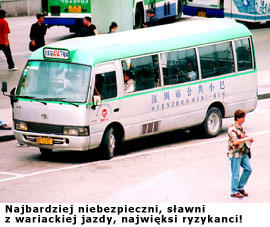 To better illustrate how people drive in the Middle Kingdom, I'll present a kind of unofficial traffic code that I've compiled from years of observing Chinese roads. Cutting people off and forcing your way into traffic don't really exist as concepts. Instead, there's one simple rule: **first come, first served!** Pedestrians and cyclists are your greatest enemies, so either force them to jump onto the sidewalk or shoulder—or simply run them over like stray dogs. A red light? It means nothing. If you're brave enough, just drive through it—nothing will happen to you. Another favorite technique, especially among minibus drivers, is bypassing an intersection. If the light is red for going straight, simply turn right, cut across the cross street (even if pedestrians are crossing), end up perpendicular to your original road, make another right turn, and you're back on your route while all the fools are still waiting at the red light. Besides the rule of "first come, first served," there's another: **the bigger you are, the stronger you are.** Nobody starts a battle with a truck, container tractor, or bus. Next come delivery vans, passenger cars, smaller cars, motorcycles, mopeds, bicycles, and finally pedestrians, who are treated like worthless obstacles by the average driver. Most drivers also seem unfamiliar with turn signals. In fact, I sometimes suspect that indicators are optional equipment on Chinese cars and have to be specially ordered.
Pedestrians, however, have it the worst. Nobody pays any attention to them, and a green light for pedestrians means virtually nothing. While people are crossing the street, cars from the parallel road are allowed to turn both left and right. There may not be traffic coming directly toward you, but there will always be vehicles approaching from the left and the right. And no driver feels any obligation to yield to pedestrians. I myself have nearly been hit several times while crossing legally at a green light. I understand that China has an enormous population, and if pedestrians were given complete priority, traffic would hardly move. But that doesn't justify applying the law of the jungle on city streets, especially in huge metropolitan areas. Not everyone is used to this kind of road anarchy. After all, thousands of tourists, as well as Europeans and Americans who live in China permanently, have to deal with it too. Once, a Canadian compared riding in a Chinese minibus to riding a roller coaster in an amusement park. Meanwhile, Chinese people cannot understand why I get upset when someone cuts me off or stops ten centimeters from my leg. They are simply used to it. I've never seen one driver yelling at another for cutting them off, driving two centimeters away from their vehicle, or leaning on the horn nonstop like a maniac.
If Polish traffic police had to work in China, they would probably stop every single driver, assuming they were all drunk. What's the difference between a drunk Polish driver and a sober Chinese one? Practically nothing. Both constantly change lanes, fail to maintain a steady speed, cut people off, ignore right of way, overtake recklessly, turn left from the right lane and vice versa, never use turn signals, and keep honking all the time. Chinese police generally don't care if someone drives through a red light or forces pedestrians to jump out of the way—that is considered perfectly normal and happens everywhere. They usually intervene only after accidents or when a vehicle is illegally parked. In Yangjiang I even saw police photographing illegally parked cars at night, yet not a single officer seemed concerned that groups of pedestrians couldn't cross the road because reckless scooters were threatening them from every direction. Once, a traffic official (not a police officer) actually tried to stop me after a driver had cut me off while I was cycling. In the official's opinion, I was the one obstructing the driver—not the other way around. If Chinese police actually enforced traffic laws and fined drivers for every violation, every illegal maneuver around an intersection, and every red-light offense, they would surely become the richest traffic police force in the world.
Perhaps a few real-life examples will paint an even clearer picture. Yesterday, one impatient driver approached an intersection using the right lane—where there happened to be no queue of cars—and then simply turned left. He crossed three straight-ahead lanes (fortunately the light was red), drove around pedestrians on the crosswalk, and made a U-turn. Imagine making a left turn across a four-lane road from the far-right lane! Every competent Chinese driver seems capable of blocking even the widest road or the largest intersection. All it takes is forcing your way into the junction, blocking a bus, or creeping into the middle despite having absolutely no chance of continuing. After all, if I'm stuck, why shouldn't I block everyone traveling perpendicular to me? I've witnessed this situation at least twenty times. Once the entire intersection is gridlocked, everyone simply sits patiently in their cars, staring at each other as if waiting for a miracle—or perhaps a helicopter that will lift their vehicles away. Several times I have been standing in the middle of the road when suddenly a driver appeared behind me, turning left or right from the cross street without the slightest intention of stopping. What exactly am I supposed to do? Teleport? I've forced several drivers to stop, and one even received a smack with my umbrella. On another occasion, I was crossing the road with an elderly Chinese man. A car approached at considerable speed. I stopped to force the driver to slow down and let both of us pass. The driver actually stopped—but the moment I crossed, he accelerated, cutting off the old man behind me. He looked genuinely proud that his car was faster than the steps of a seventy-year-old pedestrian. Whenever Chinese drivers approach a busy intersection, they usually change lanes a dozen times in search of whichever lane appears to be moving fastest. Naturally, this is when collisions happen most often. Cars frequently drive side by side in the same lane until one finally gives way, sometimes with only two to five centimeters separating them. Quite often neither driver yields, resulting in a crash and a blocked lane. Fortunately, I've never been involved in a serious accident. Once, however, while cycling at a fairly slow speed, I noticed a parked car's door opening at the very last second. It was too late to avoid it. A kind driver had simply opened the door without looking. I flew over the handlebars and ended up with a bruised finger and a few scrapes. The driver merely said, „Really sorry.” I didn't argue or fight with him because, in his opinion, nothing serious had happened. He had simply come with his wife and young child to admire the sea. He was probably luckier than I was, because had I been Chinese, I would most likely have demanded financial compensation.
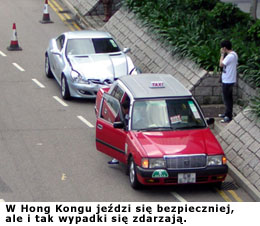 Some Poles who spend only a short time in China laugh at the chaotic traffic and claim that, despite everything, there are very few accidents. That simply isn't true. Accidents happen everywhere, and minor collisions are probably more common than drivers using turn signals. Personally, I see at least one accident every week. The undisputed champions are illegal taxi drivers, who never pay attention to where they're going or how they stop—as long as they can pick up another passenger. The bodywork of their cars is like a record of every scrape, dent, and collision they've ever had. Minibuses are much the same, stopping literally anywhere whenever someone shouts that they want to get off. Large buses are no better. At intersections, some passenger car always tries to overtake them or squeeze ahead, often ending up crashing into the bus's wheels or rear end. In many towns, scooters and motorcycles dominate the roads. They hit pedestrians almost daily—usually causing nothing worse than bruises or knocking someone over. There are also motorcycle taxis, whose drivers will cut off absolutely anyone, ride onto sidewalks, and squeeze between barriers or traffic cones if it helps them reach a potential customer.
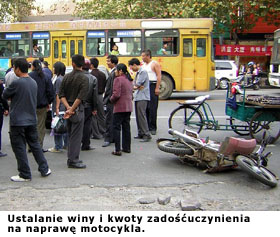 Human health and life seem to count for very little, while money means everything. After every accident or collision, bargaining immediately begins. Poorer people are often not particularly upset if an expensive luxury car knocks them off their bicycle. They simply negotiate a few hundred yuan for a new bicycle and compensation for their bruised leg. I've even heard stories that in Hunan Province some poor villagers deliberately looked for opportunities to be hit by cars so they could collect larger compensation from the drivers. I never witnessed this myself, so I can't confirm it, but I suspect there may be some truth to it. Cars in China are incredibly expensive, especially European and American brands. Drivers might spend 100–200 RMB on toll roads, so why not simply hand those same 200 RMB to the farmer they've just knocked over? For some people, that's enough to live on for an entire month. Both sides understand the situation perfectly. The driver wants to avoid trouble, the police, and wasted time. The villager knows that the police might simply chase him away or even fine him for obstructing traffic. So, from a purely practical point of view, it's often better to get knocked around a little and earn some money than to insist on proper enforcement of traffic laws.
Perhaps the greatest absurdity is that minibus drivers regularly run red lights, taxi drivers also rush through intersections without looking, while ambulances with flashing lights are often stuck in traffic jams because no one bothers to make way for them. And that, more than anything else, illustrates the absurdity of road traffic in China. Rules? What rules? There are no rules on these roads—only freestyle.
If you are interested in quoting my words, or would like
to republish or print my texts, please contact me using the form below.
contact form.
Comment:
comment added on 19.10.2008, godz. 17:39
Swietny artykul. Mozna sie posmiac, a co najciekawsze - taka jest rzeczywistosc :)
comment added on 29.6.2007, godz. 00:39
To jak w takim razie jeżdżą pijani kierowcy ?!?!
comment added on 24.6.2007, godz. 14:47
chyba tam nie pojade , a mialem taki zamiar :) chce jeszcze pozyc troche :):)
comment added on 30.12.2006, godz. 22:30
Nieco przerysowane, ale generalnie tak jest.