
Chuppies – China's New Rich
2006-08-06
Bartłomiej Magierowski
Susan Cheng is twenty-nine years old. She is considering replacing her Citroën with a newer and more expensive car. She is also thinking about buying an apartment. A second apartment, because she bought her first one at the age of twenty-six. When I ask her when she plans to buy the new car, she keeps saying that she does not have time to visit a showroom; money is not a problem for her. Susan works for a large financial corporation and privately she also invests in the stock market.
Coco, a 28-year-old woman from Shenzhen, does not have to worry about the household budget. Her husband has been trading real estate for many years, they both drive new BMWs, and their daughter attends a private kindergarten (which costs more than private university studies in Poland). Until recently Coco helped her husband, but now she works for another company - she wants to be independent. She complains about the lack of free time, but only a few months ago she regularly travelled to Thailand with her sister-in-law. Sightseeing? No, diving, because after all there has to be some way to spend money. Diving equipment is not cheap, and professional courses and boat trips out to the open sea are even more expensive. It is difficult to meet her on weekends; she usually travels to different parts of China, and she is also planning a trip around Europe. When in one restaurant I pay one hundred yuan for food that we could not even finish, Coco says: - But it is so cheap here!. She also has no intention of taking anything home in a package (although many people do this). The average Chinese person spends ten to twenty yuan a day on food (around five to eight zlotys). Coco often exceeds such expenses, rarely eats at home, and most often goes to the best restaurants, not only in Shenzhen - if she feels like it, she can always fly to Shanghai. Sometimes, during a meeting with several friends, she spends five hundred to one thousand yuan (some poor rural families spend that much during an entire year). Coco also does not have to worry about her little daughter, because the girl stays with a hired nanny.
Does tasty mean expensive?
Young Chinese people are getting richer day by day - the term chuppies has already appeared, describing the strong, newly wealthy, independent and consumer-oriented society of the Middle Kingdom. Until recently they did not even know what entertainment was; their lives consisted of constant work, stress and worries. Now, on weekends, they queue up at golf courses, go to very expensive fitness clubs, have private trainers, and also enjoy playing billiards or snooker, of course choosing the most expensive clubs. They do not need to spend hours in the kitchen or clean their apartments; they can always eat in a decent restaurant and hire a maid or housekeeper to clean their rooms.
 European restaurants are also becoming increasingly fashionable, where chuppies pay one hundred to two hundred yuan for an ordinary steak. They can also pay fifty yuan for coffee at Starbucks, or spend the same amount in the Haagen-Dazs ice cream chain. They do not go to cheaper restaurants, even if the food served there is tasty and typically Asian. They prefer sophisticated flavours and higher prices. The best proof of this is the fact that restaurants offering simply expensive dishes (not always tasty) have the most customers (sometimes in the evening you actually have to wait for a table outside).
In Beijing, Shanghai, Guangzhou or Shenzhen, nobody with a full wallet goes to bed at ten o'clock at night. Night is the time for entertainment in karaoke clubs and discos. In the most exclusive ones, people spend in one night the equivalent of a monthly salary of a factory worker or supermarket employee. Sometimes even such an expense is not enough. Forty-year-old Mrs Yang spends entire nights gambling with money in mahjong or cards, and sometimes she also bets on horse races. She does not need to work - thanks to Deng Xiaoping's plans (turning Shenzhen into a powerful metropolis competing with Hong Kong), she received twenty-six apartments as compensation for the land she lost. Now she simply rents them out. Every month she earns fifty thousand yuan from this (around twenty thousand zlotys). Her daughter will create another generation of young chuppies. They will never experience hunger, unlike their grandparents several decades ago.
Living in luxury
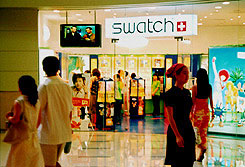
Chuppies love designer clothes. Interestingly, Adidas or Nike are not the leaders here. Their domestic manufacturer Li-Ning (a famous athlete) offers excellent sports collections, shoes and sports equipment. Prices are not much lower than those of global brands, yet there is no shortage of customers. Adidas, Nike and Puma design special collections intended exclusively for the Chinese market; prices are often higher than those in Poland. New shopping centres are also filled with luxury boutiques of global brands - Tommy Hilfiger, Louis Vuitton, Hugo Boss. Chinese brands often already match them in terms of price and quality. Today, many Chinese women spend six hundred to one thousand yuan on a dress, while their peers in Poland look for clothes on sale for sixty zlotys. French perfumes are also appearing (much more expensive than in Poland). There is no shortage of customers.
 When it comes to electronics, they increasingly choose Japanese products, focusing on quality. Due to customs duties, all branded laptops, digital cameras and phones are generally more expensive than those available on the Polish market. Despite this, chuppies no longer look for cheap "brand" counterfeits such as "Panascanic"; today official stores offer Sony phones, Canon cameras, LG washing machines, JVC audio equipment and Philips televisions. It is difficult to find the distorted letters in brand names that fooled customers only a few years ago. Today, Chinese people in large cities can afford original top-quality equipment, the same products offered in the USA and Japan.
- We can buy all of this cheaper in Poland – said fifty-year-old Mirosław, who visited Shenzhen for business purposes. Looking at the prices of the best MP3 players, branded clothes (including Chinese brands), phones and laptops, he completely gave up shopping in China. When he asked sales assistants at the Sun Plaza department store about the price of ordinary sunglasses and was told they cost three hundred yuan, he was shocked. – I can pay thirty, but three hundred? In China, expensive brands now matter, which often disappoints tourists from the USA and Europe. They have to search for cheaper markets because they cannot afford branded clothes, perfumes and quality electronics in the Middle Kingdom.
"Friends" as a role model for chuppies
Many chuppies have their own companies or work in independent professions. Some earn so well that they simply quit their jobs and rest for several months, often travelling. They go on holidays or organised tours. The most popular destinations are Beijing, Shanghai, Hangzhou, Yunnan and Guilin. Jessica quit her job a few months ago. She lives off her savings, invested in her hobby and completed a paid beauty course. Recently she travelled to Yunnan for a week, and because China is such a large country, people fly by plane here in order not to waste time.
Chuppies follow the example of their counterparts, mainly from America. Just like the characters from the TV series „Friends”, they want to spend time in pleasant cafés, change jobs, travel, organise parties and dress well. They want to be fashionable, achieve success, become business sharks and bring pride to their families. Journalist Xu Lin (who is himself a chuppie) confirms that they are inspired by overseas culture and the American lifestyle: - We love watching the NBA, we meet in McDonald's or KFC. We continue the „American dream”.
Getting rich is a source of pride
Everything began with Deng Xiaoping's reforms. Harvard specialist Anthony Saich recalls the leader's words: - The time has come to prosper. China was poor for thousands of years; becoming wealthy is now a source of pride. For young Chinese people who believed these words, nothing seems impossible. They begin with good education, then their first job, another one with a better salary, and in the future a large corporation or their own business. First come ordinary, everyday dreams: buying a newer mobile phone, earning enough for their own laptop, saving for the first instalment on an apartment, and later - well, appetite grows with eating - another apartment, a car, the best school for their children, exclusive holidays abroad.
Chinese authorities continue Deng Xiaoping's policy. Professor Qiu Dong from the Central University of Finance and Economics, who is also a Chinese National People's Congress deputy, says: - The Chinese government attaches increasing importance to the quality of economic development rather than only its quantity. The best proof of this idea is the army of young, wealthy Chinese people who simply live better and better.
One hundred million chuppies are now creating China's middle class. This number will continue to grow every month. They are not involved in politics, they do not worry excessively, they do not complain; they simply work for their own success. However, a problem appears, mentioned in "People’s Daily" by Wang Dongming, a businessman from Beijing: - If the gap between the rich and the poor continues to grow, China will not be a stable country, which may affect all of us. It is certain that the number of wealthy people is increasing, but armies of beggars in large cities are not disappearing, not to mention poor families from provinces and villages deep inside China. The hope is that young people will join the ranks of chuppies and, in doing so, help their poorer peers or families who remained somewhere in the countryside.
In China, despite everything, there is no room for complaining or sitting with folded arms. Here, wealth is fashionable, and even a young factory worker dreams of owning his own factory. In 21st-century China, such dreams can come true.
The article and photographs come from the O2.PL portal
If you are interested in quoting my words, or would like
to republish or print my texts, please contact me using the form below.
contact form.
Comment:
No comments to display.