
Five People per Square Meter
2007-03-13
Bartłomiej Magierowski
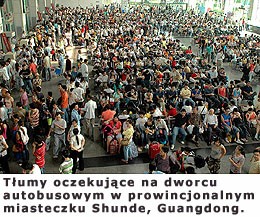 At a time when the Polish government is considering increasing the birth rate, encouraging people to start families through the so-called baby bonus, and has recently been pointing out the harmful effects of condoms, China faces the opposite problem. China's population continues to grow, and the excess number of men compared with the number of Chinese women is also worrying and creates new problems.
The one-child policy mainly affects poorer families. It is in rural areas where people are forced to undergo abortions or simply do not receive permission from local authorities to have more children. In big cities the mentality is different, and women themselves go to hospitals to terminate unwanted pregnancies and continue their careers in trading companies or large corporations. Educated people also have no problem accessing contraceptives, but in villages and small towns there is little awareness, practically no sex education, and family planning often becomes a matter of chance.
Zhang Weiqing, the minister responsible for population and family planning, admits: - Over the next five years, China expects another increase in population, and the first children from the 'one-child' generation are now entering reproductive age, which makes it even more difficult to maintain a low birth rate. The one-child policy seems to be losing its effectiveness because more and more Chinese people can afford to pay financial penalties for additional children. Thirty-year-old Yao complains that his wife wanted a boy, but they had a daughter: - My wife wanted to terminate the pregnancy when she found out we would have a daughter, but I persuaded her not to do it. Now she wants a second child, a boy, so I am saving money. Yao's situation is not easy, but the factory where he handles foreign sales is doing quite well and he will probably manage to save enough money for another child. Henry Yao and his family are an example showing that the one-child policy is no longer effective in the Middle Kingdom. - Such a policy no longer helps; it only changes the nature of the problem - stated Zhang Juwei, a professor at the Chinese Academy of Social Sciences, who has studied population issues in his country for years. In China, there are 1.8 newborns per woman. This means that theoretically every woman has almost two children.
In China, men often support the entire family. Being managers in good companies or owners of their own businesses, they are responsible exclusively for family finances. Many people therefore do not need to save money, because their financial status allows them to have three or four children. It is not difficult to meet non-working mothers with two or three children who spend their entire days shopping or playing with their children in parks. A Chinese woman who wants a career does not necessarily have to give up motherhood; many can afford childcare. If we assume that the next generation will be equally wealthy and will create similar families, it is not difficult to calculate that the population of the Middle Kingdom may continue to increase systematically.
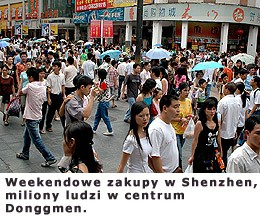 Shenzhen is the city with the largest migration in all of China. Over the last seven years, its population has grown from four million to ten million. There are five people per square metre in Shenzhen. For comparison, in Wrocław the number of inhabitants doubled over a period of forty-two years. If the metro system had not been opened in Shenzhen two years ago, the city would probably be paralysed today. Every evening at the Hong Kong-Shenzhen border, around two hundred people wait for taxis, sometimes standing in line for an hour. Shopping centres, hypermarkets and markets become seas of people every weekend, where one must know how to move. Why not go to a park? There it is also impossible to escape crowds of people. Sometimes entering Lian Hua Shan Park in Shenzhen requires standing in a queue, and hundreds of people accompany us all the time. Crowds and noise are especially exhausting; constant rushing, pushing and stepping on others without any apology are everyday occurrences here. Clinical psychologist Tatiana Ostaszewska-Mosak confirms that being surrounded by crowds is tiring, but in some sense we have to get used to it: - Generally, an excess of stimuli tires us, regardless of our limits of endurance. And an excess of people is also such an excess. One must remain alert, attentive, constantly capable of reacting quickly - after all, it is continuous social contact, and for humans this type of contact remains the most important.
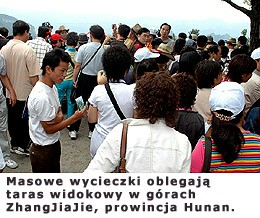
During Chinese holidays, such as National Day, Labour Day or Chinese New Year, trains, long-distance buses and planes are simply overcrowded. People can sit for twelve hours, even dozing in the passage between seats. During this period, a ticket for an ordinary train from Shenzhen to Changsha in Hunan Province must be purchased five days in advance. Tourist attractions and famous destinations such as Beijing, Xi'an, ZhangJiaJie, Hangzhou or sunny Sanya experience an invasion of domestic tourists. Only Chinese people can enjoy such trips when at every step they have to wait in queues or push through thousands of people.
Hong Kong has also opened itself to tourists from China. This special administrative region has around seven million inhabitants, approximately six people per square metre. If we add Chinese tourists and millions of visitors from Europe, the USA and Australia, we get unimaginable numbers. On Saturday afternoon it is better not to visit the famous market in MongKok, because you simply have to stand in queues on the pavement. On the famous Nathan Road, at the intersection with Austin Road, traffic jams among pedestrians can even occur. While Hong Kong has thousands of rules, orders and restrictions designed to organise pedestrian traffic, in other Chinese cities a person is simply overwhelmed by crowds, by an anonymous mass that dictates to individuals where they should go, where they may stop and how much time they have to eat lunch before a queue forms for their table. Many inhabitants of the Middle Kingdom have become accustomed to such a life, because even at school it sometimes happens that one class consists of 50-60 students. Being among such crowds and being part of a collective makes it possible to adapt to this way of life. The best example is the statement of a certain taxi driver. Three Poles travelling by taxi from Hong Kong airport to their hotel heard a very strange comment. The driver, a native resident of the region, told them that he had spent several years in Canada but could not live there peacefully; the constant rush and fast pace of life made him return to the calm (according to him) Hong Kong.
Thirty-year-old Vicky, a Chinese woman who this year travelled with her husband on a tour of Europe, constantly complained that it was so empty there. Showing me photos of German towns, Brussels and mountain villages in Italy, she could only see people from her tour group and nobody else. – How strange it is, everywhere there is such silence, such deserted places, a desert, even in restaurants there is complete silence, as if nobody lived there – commented Vicky, almost disappointed. Her friend Liu, visiting Wrocław, had become so accustomed to crowds that she rushed into an empty bus and quickly took a seat. After a moment she realised that there were only five people on the entire bus and that, unlike in China, there was no need to fight for a place.
The inconvenience of life in such a city is especially noticeable for foreign visitors who are not used to such crowds. Foreigners, who are becoming an increasingly large group of immigrants in Chinese metropolises, can be divided into two main groups. For example, Americans who previously lived in New York should not have major problems with crowds or adapting to life here. Similarly Indians, who also live daily among huge populations and whose country has the second-largest population in the world. Clinical psychologist Tatiana Ostaszewska-Mosak explains how most people cope with crowds: - Some people can distance themselves from it, somehow "switch off", disappear into their inner world and not allow access to themselves to the hundreds of people they encounter (often in direct physical contact) every day. The most difficult situation is probably for foreigners who previously lived in quiet provincial towns or villages. For them, life here requires some adaptation. It is possible that they cope with crowds in another way, as Tatiana Ostaszewska-Mosak explains: - There are also people who are bothered by it to some extent, but they know how to release stress, they calm down in solitude or among loved ones and can return to the crowd with new energy. The psychologist also notices that there are people who never cope well with being in crowds: - Of course, there are people who react to such an environment with irritation and increased stress levels, which over time may turn into aggression, frustration, low mood or even depression. These are people with so-called high reactivity. Many stimuli disturb them, they quickly become overwhelmed, which naturally makes functioning more difficult.
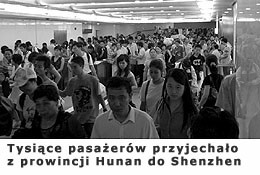 The natural population growth rate in Guangdong Province is 8% (in Poland 0.03%). This is only the difference between deaths and births, but we should also consider Chinese people arriving in Guangzhou and Shenzhen from all over China in search of a better life, as well as immigrants from the USA, Canada, Australia and European countries. This is precisely why Shenzhen's population has doubled so quickly. The number of wealthy Chinese people is also increasing. Each of them buys a car, and this is why between eight and nine in the morning and around six in the evening Guangzhou and Shenzhen become paralysed. The only solution is the metro, but there too people must wait in queues. In Shanghai, Guangzhou and Shenzhen, catching a taxi in the city centre in the evening is a real challenge, sometimes requiring risky running between cars on crowded streets. The two cities are connected by high-speed rail; trains run every 20-30 minutes, yet most of them are crowded. – Look, where do all these people come from? The trains run so often, and there are still around a thousand people waiting here! – Radek, who came to Guangzhou for a trade fair, could not believe how enormous numbers of people travel every few minutes from the capital of Guangdong Province to modern business-oriented Shenzhen. While going down the escalator to the platform, he took out his camera and photographed the sea of people that had surrounded him.
Another important population-related problem in China is the excess number of men. For every one hundred girls born, there are one hundred nineteen boys. In the future this may cause greater aggression among men, because many Chinese men will not even have a chance to find a partner and start a family; they will become frustrated loners. All of this is the result of Chinese mentality, because for many years, in their view, a daughter was considered useless for a family. The truth, however, is that many young Chinese women have well-paid jobs in large cities and support their families in rural areas. The Chinese government is already trying to influence people's mentality; in some regions financial assistance has been introduced for families with daughters. If a son is born, parents cannot have another child, but when a daughter is born, they may apply for permission to have another child. However, the question remains whether this action is already too late. The scale of the gender imbalance problem appears to be very serious even now.
 Population forecasts for the Middle Kingdom are not very optimistic. In 2025, the population is expected to exceed 1.4 billion people. However, the age structure of society will play an important role. In 1997, for every 100 children under five years old there were 80 people over the age of 65. In the future, in twenty years, it is predicted that for every 100 children there will be 250 retirees. The structure of society will therefore change; older people will form the majority, while the number of children and people of reproductive age will decrease. Only from that moment may China's population begin to stabilise.
When reading interesting facts about China, one can learn, for example, that if all Chinese people jumped at exactly the same moment, they would knock the Earth out of its orbit. One does not need to be an astronomer to understand what consequences this could have. We can only hope that the inhabitants of the Middle Kingdom never attempt such a synchronised jump.
The article and one of the photographs come from Focus magazine
If you are interested in quoting my words, or would like
to republish or print my texts, please contact me using the form below.
contact form.
Comment:
comment added on 13.3.2008, godz. 15:49
...A i na Dameishy zazwyczaj pustawo pomimo ładnej pogody :) Najgorzej wspominam Dongmen podczas Święta Pracy w zeszłym roku... chyba całe Shenzhen wyległo na zakupy! To był rzeczywiście jakiś koszmar :)
comment added on 13.3.2008, godz. 15:43
Ciekawy felietonik. Choć z tymi tłumami... nie lekka przesada? W Shenzhen odnalazłam spokój w jednym z parków - łaziliśmy po nim pół dnia i nie spotkaliśmy prawie nikogo :) Z taxi też nigdy nie było problemów... Pozdrawiam :)
comment added on 15.12.2007, godz. 13:05
lol, lol
comment added on 11.12.2007, godz. 17:33
interesujace
comment added on 13.9.2007, godz. 08:10
Sardynki?