
The Chinese Are One Step Ahead
2007-12-03
Bartłomiej Magierowski
Twenty years ago, the average Chinese person worried only about work and money for living, or rather literally - money for food. In the Middle Kingdom, where people suffered from hunger for many years, food still plays the most important role. You do not need to have a full wallet, but if you do not have rice, green vegetables and a piece of meat, it means poverty.
Of course, to this day people in many regions of China live in poor conditions. At the same time, however, the newly wealthy are climbing higher and higher, working for large corporations and enjoying life in huge metropolises.
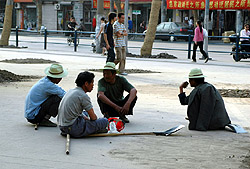 Many of us have a pyramid of needs in mind, but it is difficult to imagine that until recently Chinese people focused only on the first level of this pyramid. The most important thing was satisfying physiological needs. Even today, many ordinary people in villages, as well as workers building skyscrapers and stadiums in cities, focus only on eating and sleeping. Millions of Chinese people do not even feel secure, which would correspond to the second level of Maslow's pyramid. This is not really about a general sense of safety, because the streets are relatively safe (there is little violent crime). The problem is more complex - the vast majority of Chinese people do not have any insurance at all. Factory workers are employed on the basis of general collective contracts. They practically have no rights, and in the event of losing their health they are not entitled to any pension. When an ordinary person ends up in hospital, their family must prepare a fortune in case of a serious illness. The lives of ordinary people involve constant risk; one only needs to look at road traffic. Cyclists and pedestrians are treated as if they were invisible, and all traffic laws favour car owners.
Especially now, when new opportunities and possibilities are appearing in China, and the Middle Kingdom is developing at an incredible pace, many educated young people have the chance to fulfil higher-level needs. Sometimes they even forget about basic needs; they are so busy with work, careers, or simply spending hours on the Internet that they do not have time to eat properly or get enough sleep.
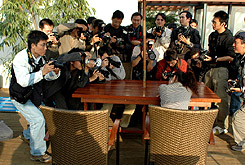 They also fulfil their need for belonging to a group. They create internet forums, organise joint trips and events, and join clubs. A photography forum in Shenzhen can gather even one hundred people for a group photo session on a Saturday afternoon. The equipment owned by these amateur photographers and photography enthusiasts is shockingly expensive, among the highest-end products. Sports groups look similar. In large Chinese cities there are usually several professional bicycle shops, but this is enough for a group of around twenty enthusiasts to equip themselves with branded equipment. The rims of their bicycles are often several times more expensive than an ordinary bicycle owned by an average Chinese person. John Liu loves lightweight bicycles; he assembled his latest MTB himself and ordered parts from the USA. The bicycle cost him around fifteen thousand zlotys. His gloves, helmet and cycling jerseys are worth the equivalent of the annual income of people living somewhere in a remote village. Practically every city and town in China boasts its own golf course. This prestigious sport fascinates Chinese people. The same applies to tennis. On many streets, young people in tracksuits offer gym memberships. Thousands of young Chinese people pay the equivalent of two thousand zlotys for annual gym access. It is not really about building muscles, but about a new, active way of spending free time.
Zhu has already visited Europe, and a month ago she returned from the USA. She does not need to stay there. She has an excellent job here in a Japanese company, and she has also bought an apartment and a car. Does she dream of working as a waitress in a bar in an American Chinatown? The choice is obvious. Claudia Cai made a similar decision; she works every day as a journalist for a local newspaper. She does not want to live in Europe because she has a good life in China, and besides, she could not function without Chinese food. This did not prevent her from spending a two-week holiday in Greece this year.
 Today, all shopping centres are built with cinemas as a standard feature, something that workers from the suburbs can only dream about. They gather in the evening in front of hypermarkets, where they watch news and television series on large screens or ordinary televisions. They will not be able to satisfy higher-level needs. Residents of metropolises live differently. Concerts, performances, Chinese opera and the cinemas mentioned above - in reality only a small percentage of China's population has contact with culture. This applies mainly to large cities; in rural areas it is difficult to find a decent book, and parents often do not even have money for ordinary used school textbooks. Thirty-year-old Liu remembers how her father refused to buy her a book, but at the same time spent money on cigarettes. Education and books no longer belonged to satisfying physiological needs, but nicotine hunger could be considered one of such needs. Today's students in beautiful, modern schools in Shanghai, Beijing and Shenzhen not only have access to various books, but also to multimedia learning tools.
 Some people desperately want to fulfil the need to stand out. Programs such as Idol are already common on Chinese and Taiwanese television. Young people try to gain public recognition through their singing and dancing skills, and sometimes simply through jokes and performances. Some succeed and appear on album covers, give shocking interviews in colourful magazines and become adored by crowds. Of course, censorship does not allow the kind of vulgarity that is promoted by Doda in Poland, but nevertheless these people can completely change their lives. They become recognisable, unique and gain respect. In this way they move three levels above the needs of ordinary people.
Unfortunately, not everyone becomes an Idol star! Not everyone can fulfil higher-level needs, because this is connected with education and money. Education in China is very expensive, although in large cities there are various universities, courses, beautiful library buildings, bookstores the size of our hypermarkets, and the amount of English-learning materials can be counted in tonnes - but does every Chinese person have access to this? If people cannot satisfy their basic needs, do they think about developing hobbies or investing in education?
If you are interested in quoting my words, or would like
to republish or print my texts, please contact me using the form below.
contact form.
Comment:
comment added on 4.10.2008, godz. 12:58
Wybieram się niebawem na dłużej do Pekinu, ... nieocenione źródło informacji te twoje felietony, dzienniki.
comment added on 12.4.2008, godz. 13:33
Świetny felieton, czytam juz ktorych z kolei i coraz bardziej fascynują mnie te rejony:)