Is Democracy Still Working?
2020-11-06
Bartłomiej Magierowski
The current situation in the world strengthens my belief that democracy has stopped working. China handled the Covid-19 pandemic quite efficiently; Europe and the Americas are clearly struggling. Not so long ago, the media in Poland criticized the Middle Kingdom for locking people inside their apartments. There were videos and photos showing entrances blocked with bricks, metal gates welded shut, and similar measures. Human rights and individual freedom are concepts that have little importance in China, and during a pandemic they practically do not exist at all. Of course, some people will say that this is ugly communism, "authoritarianism", that this society is frightened and enslaved. But is it really like that?
I know China quite well, I know many Chinese people, and I admit that I have never directly heard anyone criticize the authorities there. In most cases, this does not result from fear, censorship, or self-control. It is simply because many people are doing well in the Middle Kingdom. Young people have enormous opportunities, and the generation of people in their thirties and forties became wealthy very quickly. They truly do not see any problems with the government. Partly, of course, this is a result of censorship: society has access only to positive information and reads about the successes of the authorities. There is no information about corruption, abuse of power, forced relocation of local communities, forced labour in prisons, or camps... The disadvantages of this system could be listed for a long time. Nevertheless, the average Chinese citizen does not blame the government.
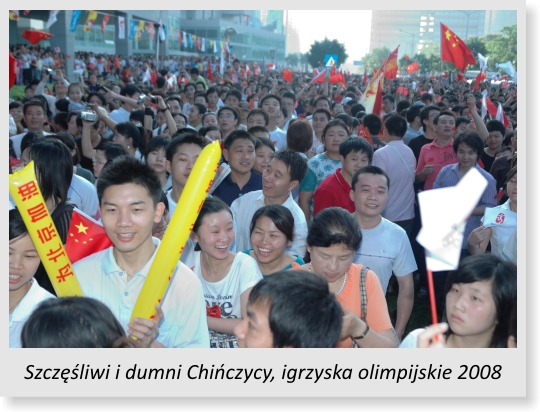
Another aspect of the discipline and obedience of Chinese society is, of course, the way children and young people are raised. There is a very strong patriotic spirit; in China, almost every citizen identifies with their homeland. I felt it especially strongly among the crowds of Chinese people who celebrated the arrival of the Olympic flame in Shenzhen in 2008. Hundreds of thousands of people came to the square in front of the huge city government building and the surrounding streets. Everyone was shouting patriotic slogans, cheering for athletes with cries of "jia-you", and hundreds of Chinese flags waved above the crowd. As a foreigner, this strength of patriotism, or perhaps nationalism, was a little frightening for me. It felt like a kind of collective patriotic madness. However, if I had been Chinese, I would probably have felt something completely different: a unique feeling, incredible excitement, one nation, everyone together, standing shoulder to shoulder. People there have different opinions and different lifestyles, but they are all family, all brothers and sisters (these expressions are actually often used when speaking about classmates, friends and colleagues). All of this connects people. It is not only that during times of crisis, pandemic, war, risk or danger they unite — they are united all the time.
 This was clearly visible during the coronavirus pandemic at the beginning of 2020. There was no endless discussion about whose fault it was, who should build temporary hospitals, why doctors and nurses were not earning more money, or why people had to wear masks. In China, there was one front, one huge army fighting against the pandemic. An army literally and figuratively. The authorities in China have always involved the military and police in fighting against all kinds of difficulties. During floods, the army is able to build a "human bridge" using ropes and soldiers. During the fight against the pandemic, those soldiers were doctors and nurses. They also did not ask how much they would earn from it or why they had to travel to another province. They also had their own families and were afraid of the risks. However, such discussions did not take place, because they treated it as a mission. A task assigned by the homeland — the homeland that now needed medical workers more than ever before.
Where is the individual person in all of this? Where are his rights? They do not exist! There is simply the mass. A mass that must follow established rules. From a humanitarian point of view, this is terrible, but thanks to this attitude China managed to deal with the coronavirus quickly. By trampling on individual rights, an entire society can be saved.
There were no arguments, protests or questioning of government decisions. On the contrary — everyone was thinking about how they could help, how they could change the situation and return to normality, to normal work and normal life. The Chinese treated quarantine very seriously; most people stayed at home for 5–6 weeks. Only one person from each family went shopping, usually twice a week. Considering the population density and the size of Chinese metropolises, if these rules had been ignored, if protests had occurred, if even a small part of society had refused to follow restrictions — it could have ended with millions of victims.
What was Europe doing during this time? First, it ignored the threat, even though everyone knows that dozens of planes arrive from China every day. Later came discussions, questioning the existence of any virus at all. Of course, there was also a period when most Europeans became frightened and locked themselves inside their homes. However, isolation quickly became boring. Sun, holidays, travelling, freedom! Everyone, including our governments, forgot about Covid-19. Now, facing a complete lockdown, we have protests, discussions, questioning the need to wear masks, claims that there is no pandemic and that people lying in hospitals are just actors. We also have hundreds of conspiracy theories about the virus. Politics and arguments have naturally come to the forefront. Where are the ventilators? Why are doctors and nurses missing? Why was the abortion issue raised now, causing thousands of people to go into the streets, so that they could later be blamed for increasing numbers of deaths? The authorities knew what was happening, but it is difficult to admit mistakes. Protests will also contribute significantly to the spread of the virus. Individual freedom is considered more important than the good of society as a whole. Instead of fighting the virus like the Chinese and treating it as a priority, we are arguing again. We allow ourselves to be divided by two political parties that are like a disease destroying Poland; we allow ourselves to be manipulated by the media, which represent different groups of interests. This is exactly the difference: China fought against the virus, while we fight against each other.
The ongoing counting of votes in the United States and the presidential election are another example of the decline of democracy. If a candidate we do not support wins, we immediately talk about election fraud. Delayed vote counting, suspicions of manipulation, additional votes appearing, forged ballots, and so on. We have already experienced exactly the same thing in Poland. It is becoming a standard. No society seems capable anymore of accepting election results, accepting defeat with dignity and admitting that the opponent won. Instead, there are protests, riots, destruction of shops, and increasing aggression and vulgarity. Instead of calming the situation, the media usually make it worse. There are no longer truly objective television stations or newspapers; perhaps only some radio stations still maintain a greater degree of neutrality.
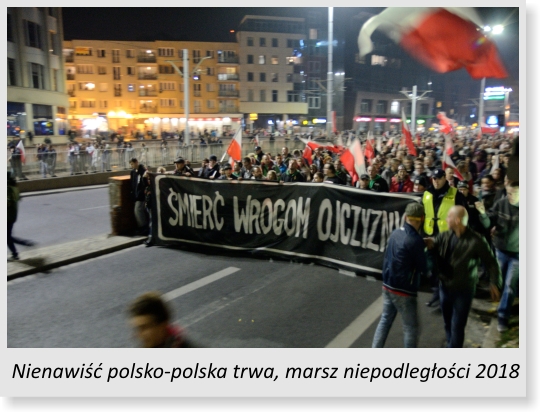 Now the question appears: does democracy still work at all? Under normal conditions, it works relatively well; it proved itself over decades. In times of crisis — such as the current pandemic — it clearly does not work well. What would happen during a more serious pandemic, for example one caused by the Ebola virus? What would happen during larger protests or nationwide riots? I have never seen one group of Chinese people arguing on the street with another group because of political views. Yes, there is no democracy there, there is no freedom of speech. But is freedom of speech really supposed to be the priority now? During a crisis, war or pandemic, should the most important things not be survival, the welfare of the state and society as a whole? Should opinions claiming that there is no virus be removed or censored right now? Should the police not deal with protesters? Where is the boundary between individual freedom and the security of the entire society? Is the abortion law affecting a young Polish woman today more important than the death of an elderly man dying from Covid-19? Why was this issue "activated" at this particular moment? I do not know the answers to these questions, but I know that disagreement is truly destroying us. Fighting each other while the real enemy is a pandemic is embarrassing. This Polish-Polish machine of hatred is running so fast that we no longer see real problems and threats. History has shown many times that for Poland such internal conflicts end very badly — with war, partitions, or economic crises. Why do we continue going down this path? Maybe it is part of our national character? I would rather see us support each other, shoulder to shoulder, just like the Chinese, and defeat a real threat together. However, this will probably remain only in the sphere of wishes and dreams, because in Poland "hatred gives birth to hatred".
If you are interested in quoting my words, or would like
to republish or print my texts, please contact me using the form below.
contact form.
Comment:
No comments to display.