
China – Wealth Is Part of Everyday Life
2006-03-02
Bartłomiej Magierowski
Recently, I asked one of my suppliers how much he pays his workers. He told me that it is around 1,200 yuan (about 500 PLN). Considering that expenses in China are half as high as in Poland, and in small towns even 70% lower, this is a good salary. China is changing, evolving! Already some people are talking about looking for suppliers in Vietnam, Pakistan, or India. China is simply becoming richer, and as a result, more expensive.
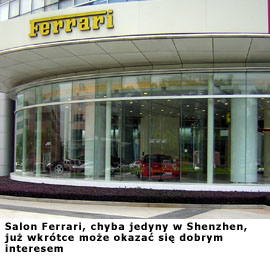
More and more often, expensive BMWs and Mercedes cars can be seen driving through the streets of Shenzhen. The first Ferrari dealerships have already appeared, and people queue up to use golf courses and tennis courts. Society in China's major cities, such as Shanghai, Shenzhen, Guangzhou (Canton), and Beijing, is becoming wealthier day by day.
The threat of widespread hunger is no longer present. A child who has obtained higher education (which is not as difficult as one might think) can confidently leave for a large city. After a few years, or perhaps even after a few months, they can support their entire family: parents and siblings who remained in the countryside.
 Shenzhen is a city of great successes and fulfilled dreams. I know hundreds of young people who became wealthy after just a few years of working here. The pattern is simple. A girl with intermediate English skills arrives by train from Hunan Province to Shenzhen. She can find a job here quite easily. There is a special job market where companies look for specialists, engineers, and office workers. It is also easy to find job offers online, and a company will quickly invite us for an interview after we simply send an email asking about employment. There is no shortage of jobs; in this city of six million people, work is everywhere. Of course, the first job is rarely perfect, but it always provides an income of around 500-700 PLN in smaller companies and 1,000-1,200 PLN in large companies, which is enough to maintain an apartment (or rent a room). Most often, companies in China provide lunch for their employees, although this is not a rule.
A young woman quickly learns new tasks, deepens her knowledge of trade and transportation, and, more importantly, has the opportunity to use English. Within a few months, she herself understands that she is valuable to her employer, and either the employer increases her salary (which is normal), or she leaves and looks for a more motivating job. Within a few months, she may change jobs several times, but within a year her salary may reach even 5,000 yuan (about 2,200 PLN). For comparison, renting a new 80 m² apartment may cost 1,800 yuan per month. A meal in a good restaurant costs around 50 yuan, while a modest meal in a popular Chinese fast-food restaurant costs only 10 yuan. These young people live modestly; they were raised this way. They quickly save money and, within two or three years, buy apartments with mortgages. Paying off a mortgage is not much different from renting because the costs are similar.
Many of these young people quickly learn the rules of business, acquire customers, and climb the career ladder through hard work. When the company they work for no longer offers anything beyond their ambitions, they open their own businesses. Sometimes they work semi-legally from home while cooperating with another company, but more often they operate legally by registering their own business. English (sometimes German, Russian, or French), computer skills, basic knowledge of trade, and basic knowledge of transportation are a guarantee of success in China. With such skills in Poland, we could at best look for an office job earning around 1,000 PLN per month. Our everyday living expenses are two or even three times higher than in China, while salaries are similar. The calculation is simple: an office worker in China can buy, for example, thirteen pairs of sports shoes (original Nike or Adidas brands) with their monthly salary, while in Poland we can buy half as many. The same applies to apartment rentals and expenses for electricity, gas, and water.
Sometimes the simple fact of being a resident of Shenzhen already guarantees a comfortable life. When the special economic zone was created in Shenzhen, one of five such zones in all of China, people suddenly transformed from farmers into millionaires. A forty-year-old woman received twenty-six apartments from the government in exchange for the land she lost. She rents these apartments for around 1,500 yuan per month, giving her a monthly income of approximately 39,000 yuan. What I find most amusing is that these people often ride old scooters, dress quite modestly, and spend their free time sitting on grass in parks or playing their beloved mahjong or cards.
China is becoming richer, and nobody can deny it. It can be seen everywhere. Of course, there are still poor people, beggars, and disabled people, but their proportion is decreasing. The middle class is growing stronger and quickly transforming into a high-income class. More and more expensive restaurants and cafés appear on every corner, often based on a European atmosphere and raising prices significantly. Customers still come, although one can eat better and cheaper elsewhere. Prestige matters. Golf courses and tennis courts are also common; sport is another symbol of status for Chinese people. It is also another way of spending increasingly larger incomes. One can buy a complete set of golf clubs, a leather golf bag, expensive tennis rackets, racket cases, branded balls, and designer clothing. Brands are playing an increasingly important role in China. It does not necessarily have to be Adidas or Louis Vuitton, because there are many Chinese brands here whose prices match those of global luxury names and are sometimes even higher. There is no shortage of customers.
 In most cities, various car dealerships also appear on the outskirts: VW, Audi, BMW, Mercedes. The famous VW Santanas are gradually being replaced by the newest Hondas, Nissans, Toyotas, Buicks, BMWs, and even Mercedes and Jaguars. The streets of Shenzhen are probably already more German than those in Frankfurt; most cars here are Audis, Mercedes, and BMWs. Interestingly, sports cars and more unusual models such as Porsche, Audi TT, or the new "Beetle" are often the domain of women. It is remarkable that the owners of such cars are most often women aged 25-30. Perhaps they are wives of wealthy businessmen who received impressive vehicles as gifts, but just as often they are independent women, frequently without partners. How is this possible? They achieved all of this through work, hard work. They are often managers of Chinese companies, Japanese corporations, or Chinese-American joint ventures.
You do not need higher education to live normally in such a city. There is also no shortage of jobs for people with secondary education. With a little luck, it can be an office job in a trading company. If not, there is work in supermarkets, restaurants, or clothing and electronics stores. Very often, employers provide accommodation for such workers. Most restaurants rent apartments for their cooks and waitresses. Of course, these are not luxury apartments, but for Chinese people accustomed to modest living, it is normal. They share rooms with two or sometimes three other people. Factory workers are probably in the most difficult situation, as they often live in rooms or even dormitories for six or eight people.
The phrase that someone "works for a bowl of rice" has become popular in Poland, but perhaps this applies to Poland rather than China. Factories are also evolving; they provide better conditions for workers and must maintain reasonably good wages. Otherwise, workers will quickly move to a neighboring factory offering better pay. There are also poor factories where people work in terrible conditions, with noise, dust, and sometimes dangerous chemicals harmful to health. A few weeks ago, I visited a factory with a Polish man. His comment was brief: "A factory like this would be closed immediately in our country. Look, there is no ventilation, no health and safety regulations." However, I emphasize that factories are changing. They are quickly building new production halls, seeking ISO certificates, and purchasing newer, better, quieter, and certainly safer machines. More and more often they want to attract valuable customers from Germany, the United States, England, Spain... and these customers may not accept dirt, disorder, outdated technology, or lack of ventilation.
I have also had the opportunity to visit factories that are difficult to compare with those in Europe. They were clean, huge, modern, and had enormous production capacity. These factories are appearing day by day and, in terms of cleanliness, modernity, and organization, they do not differ at all from those we know from the outskirts of European cities.
I could now write about the negative aspects of life in China. I admit that Polish newspapers have already published hundreds of bitter articles criticizing China. They were often written by journalists who came here for seven days pretending to be businessmen. They visited one factory, and the lack of ventilation and sunlight affected them so much that they wrote negatively about the entire country. They met two beggars on one of the main streets and decided to write that the entire Chinese society was poor and exploited. But that is not true! I also will not write about prisons and labor camps because I have not seen them. What I do see every day are hundreds, thousands, and millions of young people buying the newest cars, newly built apartments, playing golf on Saturdays, relaxing in the evening with a foot massage or a visit to a hairdresser, and visiting their favorite KTV (karaoke club) with friends at night. They are not interested in whether the government is communist or democratic, or whether there is censorship or not. Who cares if people are doing well?
I know several dozen people in Poland, aged 20-30, who have no jobs or work for 800 PLN. Their first job in Poland is often a miserable salary of 500 PLN per month. Honestly, many workers in China earn the same amount. My friends from Poland cannot afford new cars, and certainly cannot afford apartments. They joke that maybe in twenty or thirty years they will save enough money to buy one. Compared with the situation in Chinese cities, there are far more opportunities there.
Therefore, if someone criticizes China through the lens of its communist government, exploitation, corruption, and connections, they should first look objectively at Poland. Nobody should write about "poor China," because I do not know such a country. The Middle Kingdom is becoming richer, and when the whole country becomes richer, this also applies to ordinary people: workers, taxi drivers, cooks, receptionists, office workers, business owners, and factory owners. Of course, there are still poor regions without industry, far from tourist routes, where people live modestly. The opportunity for these people, or rather for their descendants, lies in large port cities, where there is no shortage of trading companies, logistics firms, large corporations, and factories.
 In the Middle Kingdom, there is no shame in being wealthy. Our Polish habit of complaining is certainly not a characteristic of Chinese people. Here, everyone wants to be successful: from a taxi driver buying the newest mobile phone to a businessman buying the latest BMW and a huge apartment in an expensive district. It is simply desirable to be wealthy and successful, and it does not automatically mean that someone is a fraud, exploiter, or schemer. Of course, there are still connections and corruption here, but not everyone who can afford a new car or laptop has ties to the communist government. It is simply business and trade.
I know that people still criticize China for human rights violations, Tibet, or disputes with Taiwan, but perhaps it is precisely because of this criticism that everything is changing. The situation of the average Chinese citizen is certainly improving. I observe this every day, and I truly wish that people in Poland could live with the same level of prosperity as Chinese people in Shenzhen. It may sound absurd, but if you do not believe me – I invite you to China.
If you are interested in quoting my words, or would like
to republish or print my texts, please contact me using the form below.
contact form.
Comment:
comment added on 12.7.2014, godz. 21:03
W Polsce mamy trzeci świat, bo mamy socjalizm, który nagradza nieudacznika a karze pracowitego. Do tego urzędasy i ta biurokracja. W tym kraju nie pozwalają człowiekowi wziąć odpowiedzialności za swój los.
comment added on 29.3.2007, godz. 20:41
Z autorem tego artykułu moge się w stu procentach zgodzić. Wrociłem własnie z drugiego mojego pobytu w Chinach i znowu jestem mile zaskoczony.Znajomi, no cóz nie uwierzą dopoki nie zobaczą:)
comment added on 30.12.2006, godz. 22:02
Bylem w Chinach kilka razy, teraz znowu wyjezdzam na dluzej do Shenzhen. Moge tylko potwierdzic opinie autora.
Polskie mity o Chinach - to wielka bzdura!
Gdy znajomi pytaja "I jak tam w Chinach?" odpowiadam: "Trzeci swiat". I dodaje "W Polsce".
comment added on 28.11.2006, godz. 21:10
Co z tego że milion ludzi ma dobrze, skoro w Chinach mieszka miliard osób! W Malawi też znajdziesz bogatych ludzi. Idąc twoim tokiem rozumowania to Indie są najbogatsze, bo tam najwyższa kasta ma kasy że ho ho. Nie tylko Ferrari ale i helikoptery.